A microboard built for the classroom.
A custom Open Minds microboard, designed for school hands and school benches, and programmed entirely in the browser. No IDE, no install, no software to set up.
Open Minds is two things. The methodology and the platform are one half, the hardware is the other. This page is the hardware. For the six-phase method, the card game and the research engine, see the platform.
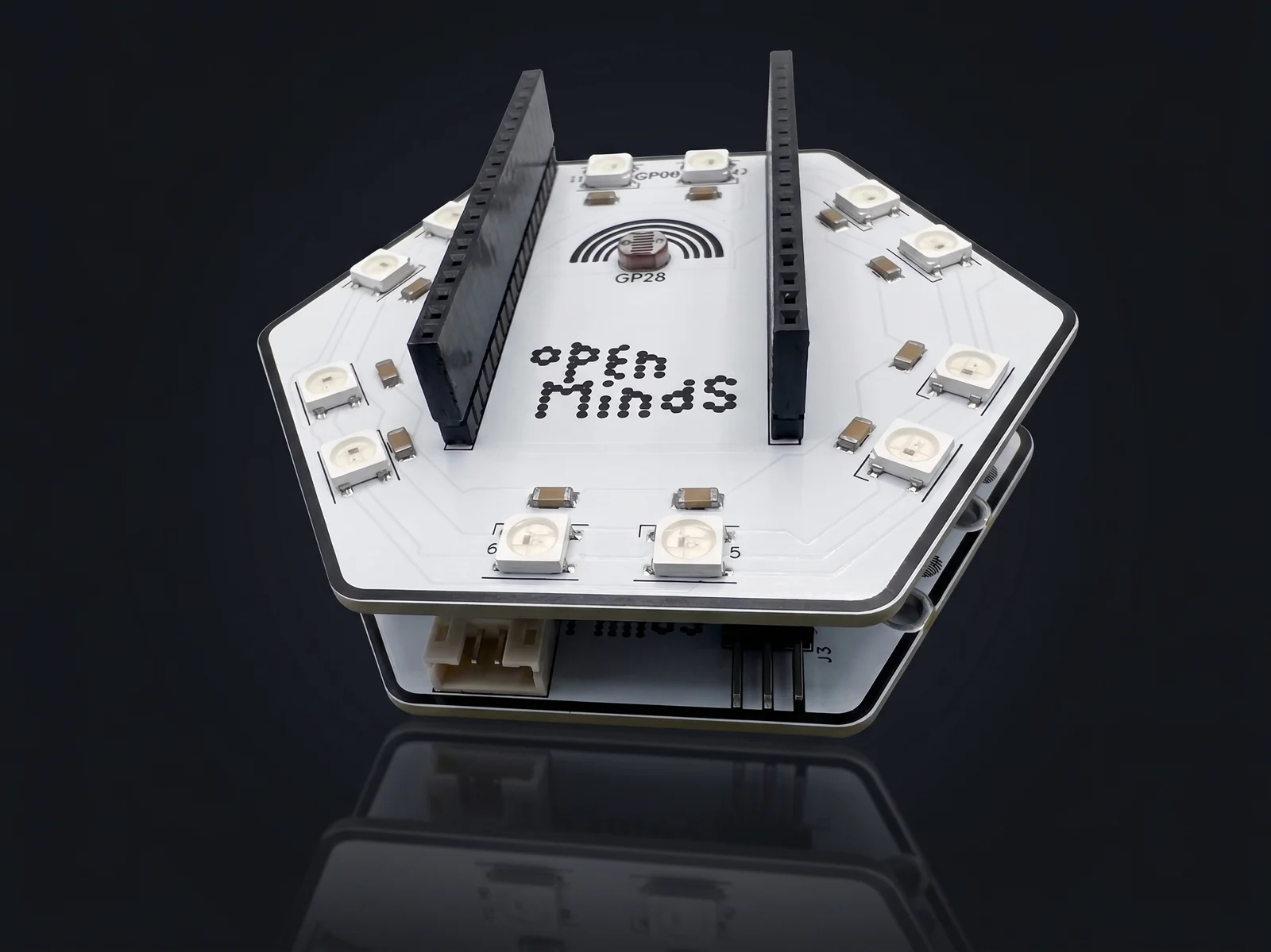
One hexagonal board, programmed where you read this.
The Open Minds board is a custom microboard with a hexagonal footprint. The shape is not decorative: it is what lets the sensor hats stack onto it, edge to edge, so a class can build up exactly the instrument a project needs and take it apart again for the next one.
It runs MicroPython, and it is programmed from this website over the browser's serial connection. A student writes code on the page, presses a button, and it runs on the board in their hands. There is nothing to download, no environment to configure, no account to provision on a school laptop. That matters in a classroom, where a lesson cannot wait on an install that needs admin rights.
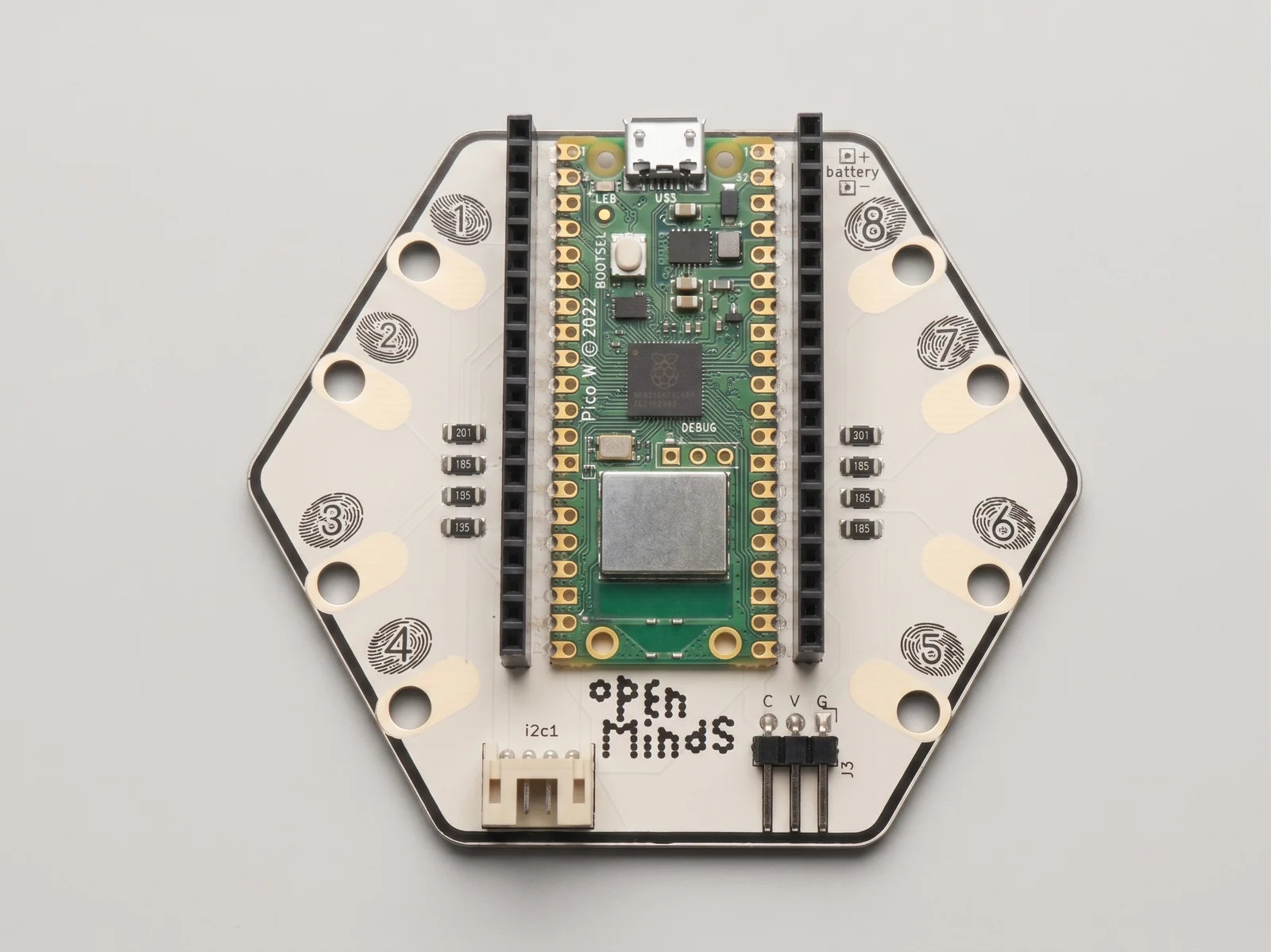
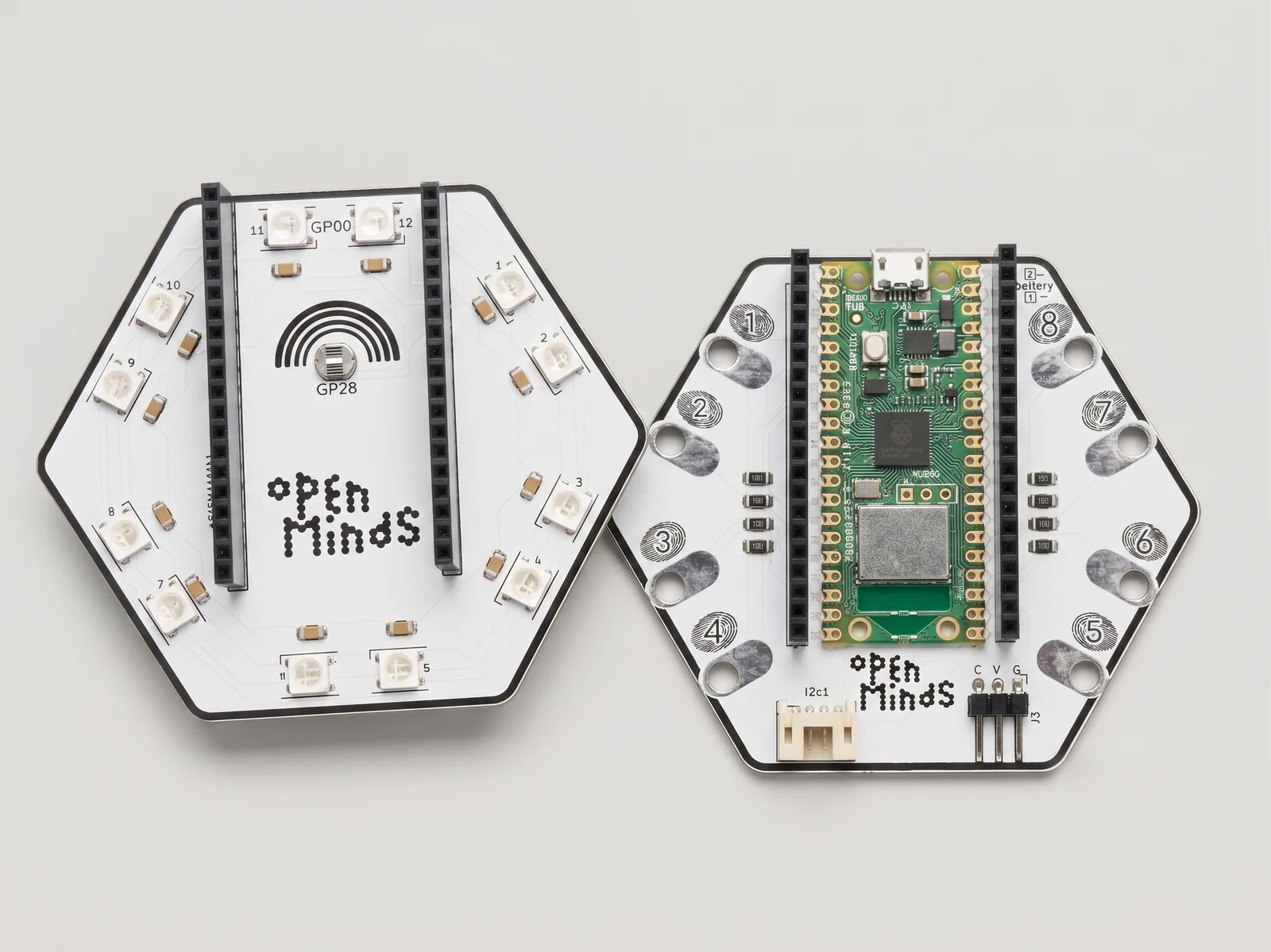
Eight capacitive-touch inputs
Touch 1 to Touch 8, ready to become buttons, sliders, conductive-paint controls or anything a student can wire to a fingertip.
Built-in WiFi
Wireless networking on the board itself, so projects can fetch data, talk to one another or report to a screen without any add-on.
A servo output
Drive a servo directly for movement, mechanisms and the first steps into robotics, with no extra driver hardware.
An I2C bus
The shared two-wire bus that the sensor hats speak over, so most of the catalogue stacks together without using up board pins.
The board runs MicroPython and is programmed from the web page over the browser serial connection. No IDE, no install, no setup: write code on the page and it runs on the board.
Start whole, then grow.
The board is a complete instrument the moment it comes out of the box. Eight touch inputs, a ring of addressable lights, a light sensor and built-in WiFi: enough for a class to make something real on the first afternoon, before a single hat is added.
Then it grows. Each sensor hat clips onto the same hexagonal footprint and speaks to the board over the shared bus, so a project becomes exactly the instrument it needs to be. Add Motion and it answers to gesture, add the Motor hat and it drives, add Distance and it senses the space around it. One board, taken apart and rebuilt, becomes a hundred projects across a year.
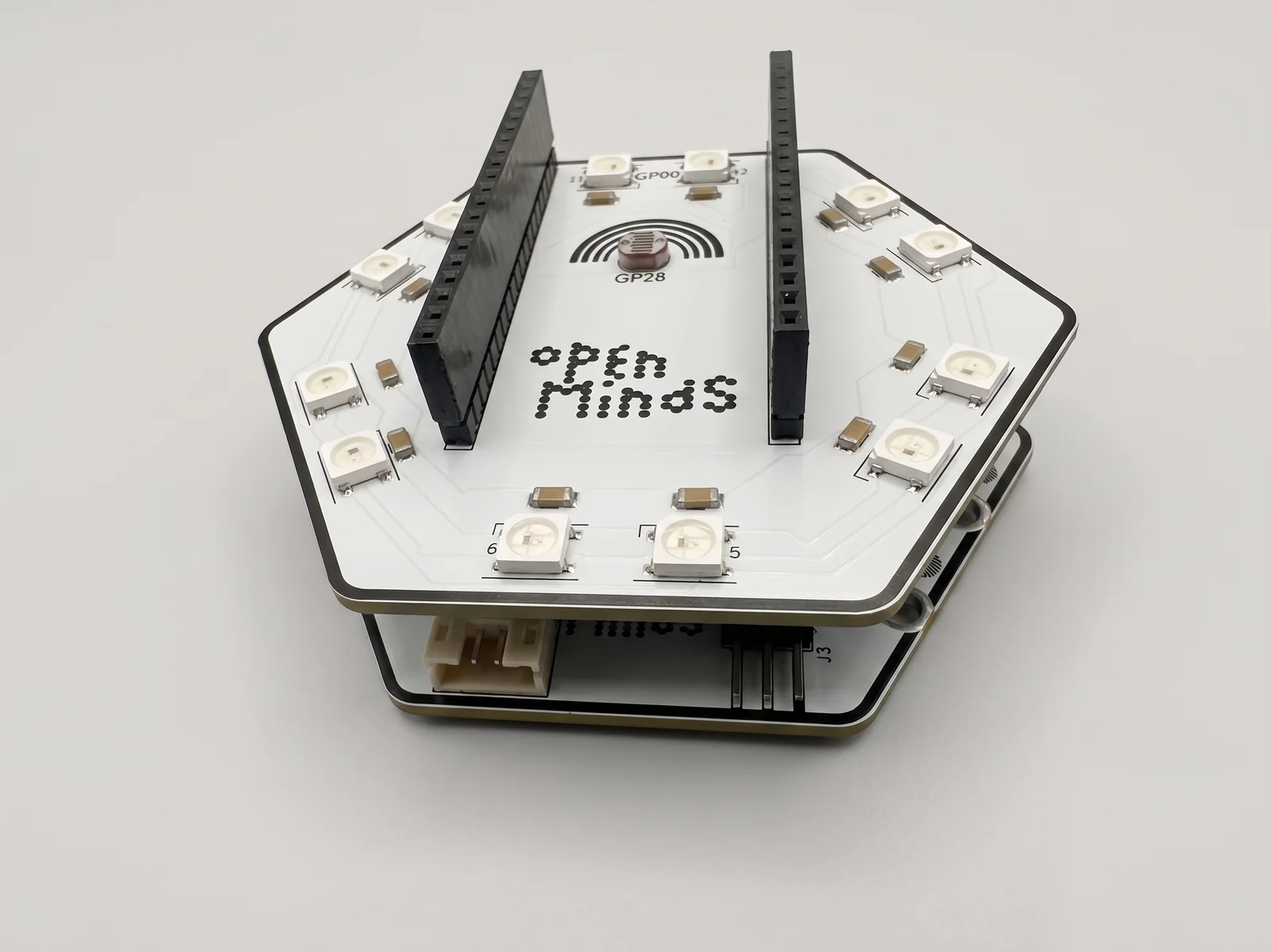
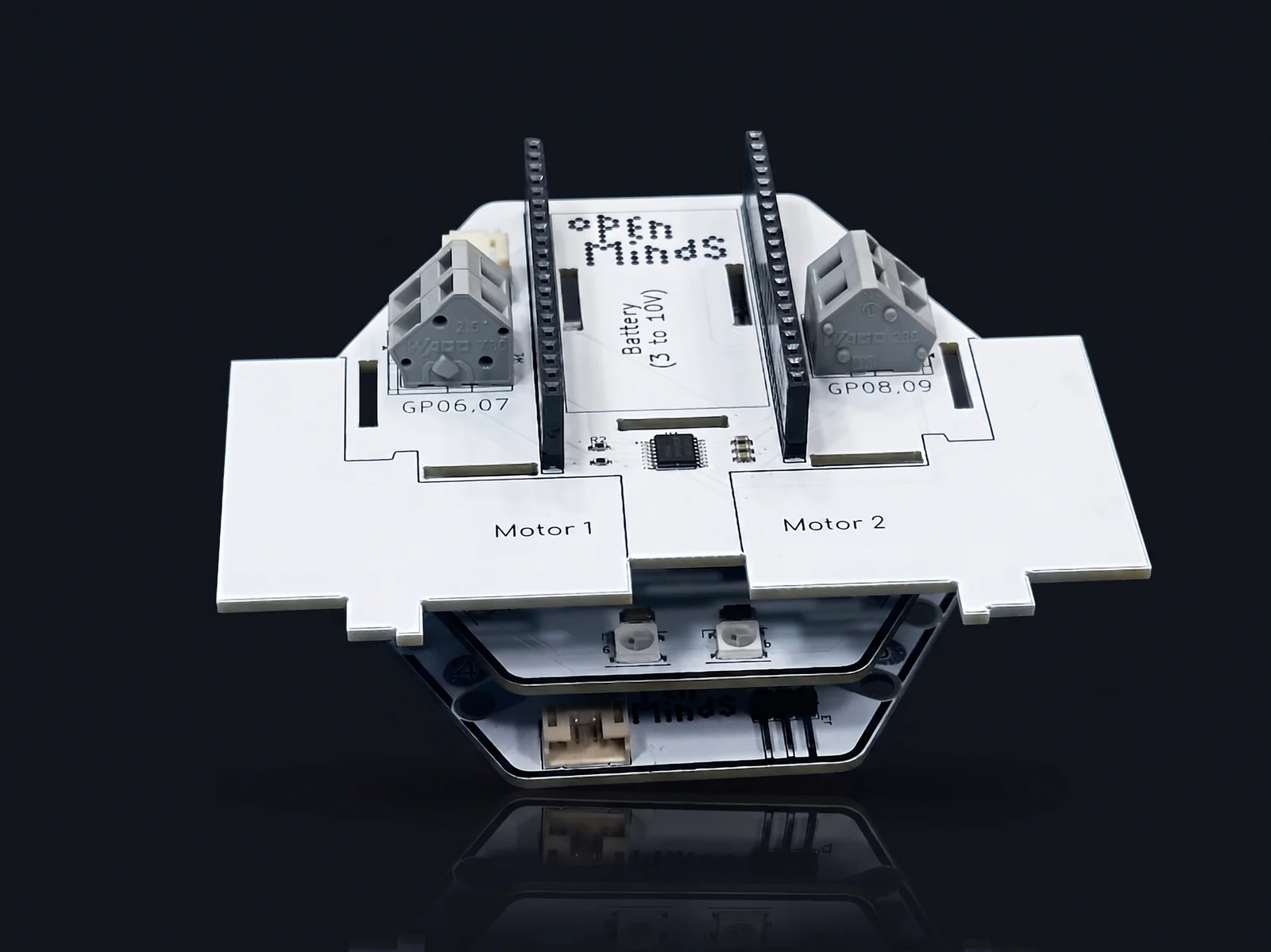
Each hat both reads the world and acts on it.
A hat is a hexagonal board that clips onto the microboard and gives it a new sense and a new way to respond. They are not sensors alone: each takes something in and puts something out, which is what lets a project notice a situation and then do something about it. That sense-and-respond pairing is the point: a project can act on the world, not just read a value and print it. Three are in classroom use today.
Light
Reads the light around it, and answers with addressable RGB LEDs that flash, glow and fade in any colour. Sensing and display in one hat.
Sound
A microphone to listen and a speaker to answer: tones, alarms, voice and sound-reactive projects that hear and respond.
Motor
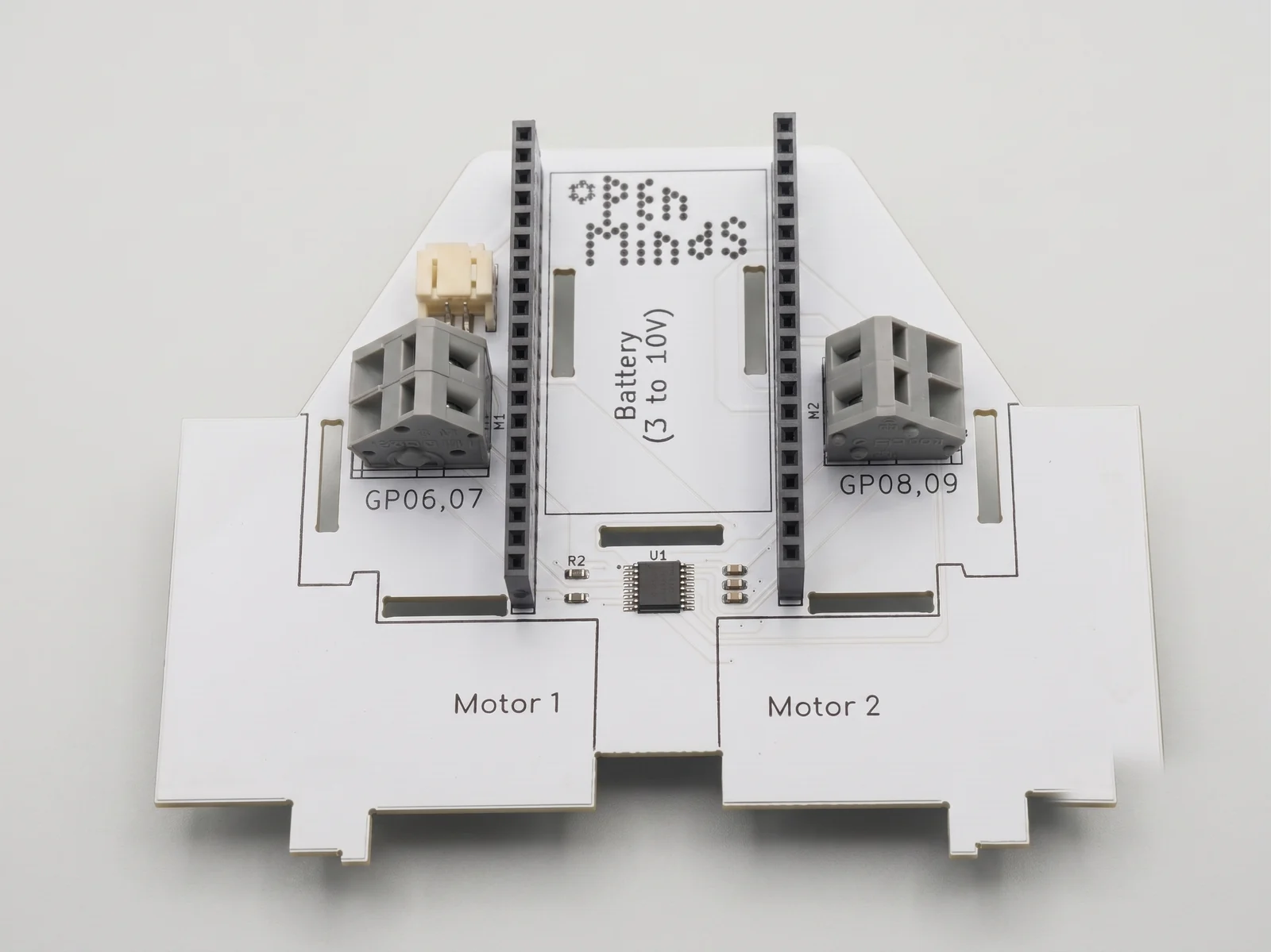
Drives two DC motors with independent speed and direction, from its own battery, for robots, vehicles and anything that has to move.
The main board does plenty on its own: eight capacitive-touch inputs, a servo output, WiFi and an I2C bus, built on the Raspberry Pi Pico. The hats extend it, and so does almost anything else.
Connect almost any sensor or output you can think of.
The hats are a starting point, not a ceiling. The board carries a Grove-compatible connector, so a class can plug in any of a huge range of ready-made modules: distance and gesture sensors, knobs and sliders, air-quality, moisture and temperature sensors, OLED screens, more lights, more speakers, more motors. They clip straight in, with no soldering.
Beyond that connector, the board breaks its remaining pins out to points a student can reach with crocodile clips or a screwdriver, so almost any other input or output can be wired in, not only the ones that speak the standard bus. And because WiFi is built in, a project can reach the web or talk to another board across the room. The principle is simple: read something, decide something, do something, with whatever the project needs on either end.
The boards, up close.
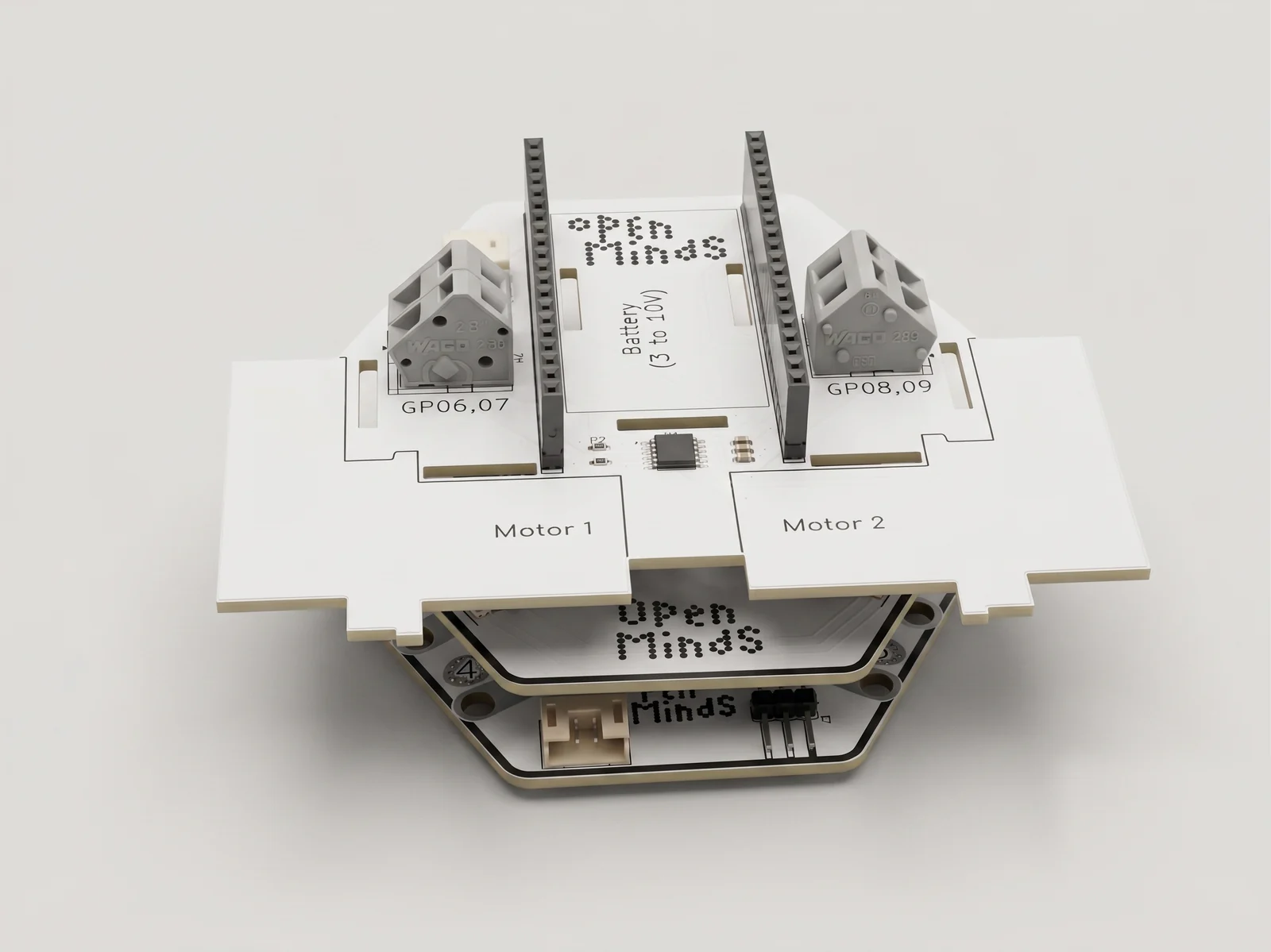
Photographed from the current production run: the main board with the Light hat alongside it, the Motor hat on its own, and a motor stack assembled.
Built for a room of fourteen-year-olds, not a lab bench.
Build your classroom kit.
Buy boards, hats and decks outright, individually or in boxes of ten and thirty for a class or a whole year group. A group can start with a single board, and the more boards they add the further a project can go: boards talk to one another, share the work, and combine their senses and outputs.
The board
The hexagonal microboard: eight touch inputs, WiFi, MicroPython, programmed in the browser.
Light hat
Reads the ambient light and answers with addressable RGB LEDs.
Sound hat
A microphone to listen and a speaker to respond: tones, voice and sound-reactive projects.
Motor hat
Drives two DC motors with independent speed and direction, for robots and anything that moves.
Sensor kit
Add-on sensors that clip onto the board over its Grove-compatible connector.
Card deck
A full Person, Condition and Environment ideation deck.
Want these now? Join the waiting list to be first to order, or enquire about a pre-order.
Indicative pricing in Swedish kronor, excluding VAT. Box pricing shown is the unit price multiplied by quantity; final launch pricing is confirmed alongside the platform.
Want boards for your classroom?
We are taking enquiries and pre-orders now. Tell us how many you need and what you are teaching, and we will work out the right configuration of boards and hats with you.
Orders are arranged directly with us for now.